Fortinet Security Solutions for Enterprise Networks
A firewall replacement is rarely just a firewall replacement. It can affect internet edge capacity, branch connectivity, remote access, segmentation policies, wireless visibility, logging retention, and the licensing required to keep protections current. Fortinet security solutions are most effective when they are specified as part of the network architecture rather than purchased as isolated appliances.
For IT procurement teams, managed service providers, and network administrators, the practical challenge is matching the right Fortinet platform, subscriptions, interfaces, and support coverage to a defined operational requirement. A larger appliance is not automatically the better choice. The correct selection depends on inspected throughput, enabled security services, port density, high-availability design, user counts, and the expected growth of the environment.
What Fortinet Security Solutions Cover
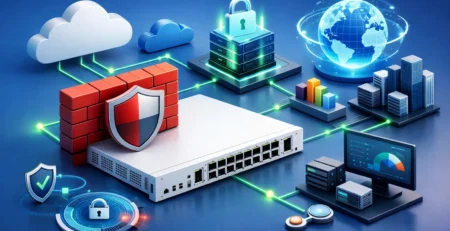
Fortinet is widely deployed for network security platforms built around FortiGate firewalls and the FortiOS operating system. In a typical enterprise design, the firewall acts as more than a perimeter device. It can enforce application controls, intrusion prevention, web filtering, VPN access, segmentation between internal networks, and traffic inspection across branch, data center, cloud, and WAN deployments.
The broader portfolio can also include secure switching, wireless access points, centralized management, analytics, endpoint controls, email security, and security information tools. Whether an organization needs all of these components depends on its existing infrastructure and management model. Many businesses retain their current switching and wireless estate while introducing FortiGate appliances at the edge or in key internal segmentation points.
That flexibility matters in mixed-vendor networks. A Fortinet deployment does not require a complete hardware refresh, but integrations should be assessed before procurement. VLAN design, routing protocols, PoE requirements, SFP and SFP+ transceiver types, authentication platforms, log collectors, and network management workflows all influence the final bill of materials.
Start With the Traffic That Must Be Inspected
The most common sizing mistake is using basic firewall throughput as the main performance figure. That number may reflect traffic handling with few services enabled. Real-world capacity changes when SSL/TLS inspection, intrusion prevention, antivirus scanning, application control, web filtering, IPsec VPN, and logging are active at the same time.
A useful evaluation starts with the traffic profile. Document current internet bandwidth, peak utilization, east-west traffic between internal segments, remote-user VPN demand, site-to-site tunnels, and applications that require low latency. Then identify which traffic classes must receive full inspection and which can be handled under narrower policies.
For example, a branch office with a moderate internet circuit may need a compact appliance if it primarily provides secure internet access and a few VPN tunnels. The same branch may require a higher model if it also terminates SD-WAN links, supports local servers, inspects encrypted SaaS traffic, and provides wireless controller functions. A headquarters deployment may need separate considerations for redundant power, multiple 10GbE or higher-speed interfaces, large VPN populations, and high-availability clustering.
Encrypted Traffic Changes the Sizing Conversation
Most business traffic is encrypted. Without inspection, a security policy may see the destination and basic session information but not the content needed for deeper threat detection. SSL/TLS inspection can improve visibility, but it consumes processing resources and introduces policy, certificate, and privacy considerations.
Organizations should define where decryption is appropriate, which user groups or destinations must be excluded, and how certificates will be distributed to managed endpoints. Capacity planning should be based on the services that will actually run after deployment, not on an initial policy set that will be expanded later.
Choose the Deployment Model Before Selecting Hardware
Fortinet security solutions can support several deployment patterns, each with different hardware and licensing implications. The right model follows the network’s operational design.
At the internet edge, a FortiGate appliance can provide perimeter security, NAT, VPN, application control, and threat prevention. In a branch environment, it may combine SD-WAN, local breakout, routing, and security services. In the data center, firewalls can segment server zones, protect application tiers, or control traffic between business units. Virtual firewalls may also be appropriate where workloads are hosted in virtualized or cloud environments.
High availability requires its own planning. Two matched appliances are normally selected to avoid a single hardware failure taking down a critical site. Buyers should confirm interface availability, synchronization requirements, rack space, power design, and whether both units will carry the same subscription and support entitlement. A mismatched pair can create unnecessary operational risk and complicate replacement planning.
Ports, Media, and Physical Compatibility Still Matter
Security architecture often receives more attention than physical connectivity, yet deployment delays frequently come from basic interface mismatches. Confirm whether the required connections are copper RJ45, 1GbE SFP, 10GbE SFP+, 25GbE SFP28, or another media type. Verify supported transceiver families, fiber type, cable lengths, and whether existing optical modules are approved for the intended appliance.
Power requirements also deserve attention. Compact appliances may use external power supplies, while larger rack systems can require redundant AC or DC power options. For regional deployments, procurement teams should check the power configuration, rack accessories, and any local import or regulatory requirements before equipment is dispatched.
Licenses and Support Are Part of the Security Design
Hardware alone does not define the protection level. Many security functions depend on subscriptions that provide updated threat intelligence, web classifications, intrusion prevention signatures, malware detection, and related services. Product selection should therefore include a clear entitlement review: what is included, what requires a separate subscription, what term is needed, and how renewal will be managed.
A low initial hardware price can become expensive if the required security bundle, support level, or future renewal costs were excluded from the comparison. Conversely, purchasing the broadest package for every small branch may not be justified when the site has limited exposure and centralized controls already exist elsewhere. The right scope is based on the site’s risk, traffic profile, compliance obligations, and operational dependence.
Support coverage is equally practical. Enterprises with limited onsite expertise, critical uptime requirements, or dispersed locations may need a higher service level and a defined replacement process. Teams with standardized spare stock and experienced network operations personnel may choose a different coverage model. Either way, record serial numbers, entitlement dates, configuration backups, and the approved replacement procedure before an incident occurs.
Management and Logging Should Not Be an Afterthought
A firewall can enforce policy, but a security program also needs evidence of what the device is seeing and blocking. Determine where logs will be stored, how long they must be retained, who reviews alerts, and whether data needs to feed a SIEM or managed security service. These decisions affect storage requirements, bandwidth, administrative workload, and licensing.
Centralized management can improve consistency across multiple locations by standardizing policy objects, firmware planning, templates, and reporting. It also introduces a governance requirement: administrators need controlled access, documented change processes, and a clear separation between global policy and site-specific exceptions.
For organizations operating across multiple African markets or managing regional branch networks, this centralized approach can reduce travel-dependent administration. It does not remove the need for local readiness, however. Reliable power, carrier diversity, remote-hands procedures, and local replacement logistics remain part of the design.
Build a Procurement Specification That Can Be Verified
Technical buyers should issue a specification that makes equivalent comparisons possible. At a minimum, define the required appliance model or performance class, interfaces, rack and power requirements, high-availability quantity, subscription bundle and duration, support term, and required delivery schedule. If the purchase replaces an installed unit, include the existing model, firmware version, configuration export status, and transceiver inventory.
For expansion projects, document the intended topology. A supplier can source hardware more accurately when the request identifies WAN handoffs, uplink speeds, switch models, optical media, and whether compatible modules or cables are needed. This reduces the risk of receiving a firewall that is technically capable but cannot connect to the environment on day one.
Exact part identification is especially valuable for maintenance events. When a failed appliance, power supply, interface module, or transceiver must be replaced quickly, procurement should validate revision, interface standards, licensing transfer conditions, and support eligibility rather than relying on a general product family name.
Fortinet security solutions work best when performance, policy, licensing, and physical connectivity are treated as one purchase decision. A precise specification gives the deployment team fewer surprises and gives the business a security platform that can keep pace with the network it is meant to protect.

I am an enthusiastic tech blogger with 15 years of experience in the technology field. I am passionate about sharing valuable insights and helping people who are interested in technology gain useful and practical information. I am originally from Mumbai, India.