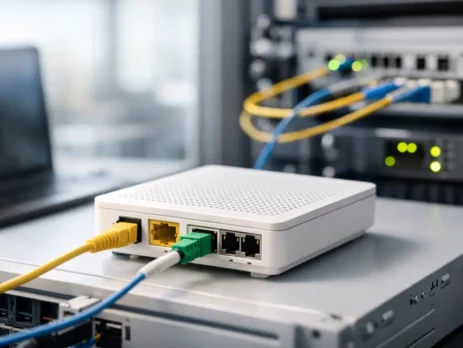
Huawei ONT for Business Fiber Networks
When a fiber handoff reaches the customer edge, the Huawei ONT is often the device that determines whether deployment stays straightforward or turns into a compatibility problem. For procurement teams and network engineers, this is not a minor endpoint. It is the access-layer device that converts optical service into usable Ethernet, voice, and sometimes Wi-Fi services, and its model-specific features directly affect installation standards, subscriber service profiles, and replacement planning.
What a Huawei ONT actually does
A Huawei ONT, or optical network terminal, sits at the customer premises in a GPON, XGS-PON, or related passive optical network environment. Its primary role is simple in concept: terminate the optical signal coming from the provider network and present service interfaces that local equipment can use. In practice, the exact interface mix matters a great deal.
Some ONT models are built for pure data delivery with one or more Gigabit Ethernet ports. Others add POTS interfaces for voice, RF output in certain deployments, or integrated wireless capability for branch offices, retail sites, or managed customer environments. For business buyers, the ONT is not just a last-mile accessory. It is a hardware dependency tied to service design, VLAN handling, QoS behavior, optical class support, and in many cases the provider’s provisioning framework.
That is why replacing an ONT with a look-alike model is not always safe. Even if the optics and port count appear similar, firmware support, OMCI interoperability, and service profile alignment can create issues after installation.
Why Huawei ONT selection is model-driven
In enterprise procurement, broad product labels are not enough. A request for a Huawei ONT usually needs to narrow quickly into a specific family, interface set, and deployment requirement. Two units from the same vendor may serve very different use cases.
A branch office with fiber internet and no voice requirement may only need a compact bridged ONT with one uplink and a small Ethernet footprint. A multi-service site may require voice ports, router functionality, NAT capability, or integrated dual-band wireless. A managed service provider may care less about consumer-style features and more about optical budget, remote management consistency, and the exact behavior under the serving OLT platform.
This is where buyers need to separate physical compatibility from operational compatibility. Physical compatibility covers items such as connector type, power input, Ethernet port speed, and environmental fit. Operational compatibility is broader. It includes registration behavior with the optical line terminal, service template support, remote provisioning, authentication method, and whether the endpoint matches the provider’s approved hardware matrix.
Key specifications to check before buying
The right Huawei ONT starts with the service architecture, not the carton label. If the live network is GPON, the ONT must match that access technology. If the deployment is moving toward XGS-PON for higher throughput, the selected device needs to support that standard and the provider side must be configured accordingly. A mismatch here stops the project before it starts.
Ethernet port layout is the next practical checkpoint. Some business sites only need one LAN handoff into a firewall or SD-WAN edge. Others need multiple ports for direct attachment of local devices, IP phones, or small access switches. Port speed also matters. A Fast Ethernet interface can become a bottleneck immediately in a business fiber environment, while Gigabit Ethernet is the common baseline and multi-gig capability may be relevant in newer deployments.
Voice support is another area where assumptions cause delays. If the site relies on analog handsets, fax integration, or provider-delivered voice over PON, the ONT must include the required FXS or POTS interfaces. If voice is fully IP-based behind a PBX or SIP infrastructure, those ports may be unnecessary.
Wireless capability deserves a more cautious view. Integrated Wi-Fi can be useful in small offices or temporary deployments because it reduces hardware count. But in structured enterprise environments, a dedicated access point architecture is often the better choice. An ONT with built-in Wi-Fi may simplify procurement for one site and complicate RF design, security policy, or replacement planning across a larger estate.
Power design, mounting format, and environmental conditions also matter more than they first appear. Desktop versus wall-mount placement, PSU type, local power standards, and thermal behavior can all affect field deployment. For distributed rollouts, consistency in accessories and installation method can save time across dozens or hundreds of sites.
Huawei ONT in business and service-provider environments
The term ONT is often associated with residential broadband, but that view is too narrow for many commercial deployments. Huawei ONT hardware is also relevant in retail chains, clinics, remote branches, hospitality sites, education environments, and managed enterprise access networks where fiber is delivered directly to the premises.
In these environments, the ONT often functions as the demarcation between carrier access and customer infrastructure. That makes support boundaries clearer, but it also means the ONT becomes a critical spare item. If a unit fails, business continuity can depend on how quickly an exact or approved replacement can be sourced.
For service providers and integrators, ONT standardization helps with support and provisioning efficiency. For end customers, however, standardization may create a narrower approved device list. That is not a drawback if procurement is handled correctly. It simply means the purchase decision should follow the live network design rather than a generic search for any optical terminal.
Common buying mistakes with Huawei ONT hardware
The most common mistake is buying by appearance or by partial part description. A device may be listed as a Huawei ONT, but unless the exact model and feature set are confirmed, it may not support the required service profile or interface mix.
The second mistake is ignoring the serving OLT environment. Even within the same vendor ecosystem, compatibility should be checked at the level of platform support and operational policy. Some networks are strict about approved serials, firmware versions, or provisioning templates. A technically functional device can still be unusable if the provider will not register it.
Another issue is overbuying integrated features that will never be used. Wi-Fi, routing, voice, and extra LAN ports all add value in the right scenario, but they also change cost, power needs, and failure domains. If the ONT is only serving as a transparent handoff into enterprise routing equipment, a simpler model may be the better procurement decision.
Underbuying is just as risky. A low-port model might look cost-effective until an expansion requires separate voice, additional LAN presentation, or a higher throughput profile. ONT selection should reflect not only the current service but also the likely lifecycle of the site.
How to evaluate the right Huawei ONT for procurement
Start with the service type and the provider’s approved device requirements. Confirm whether the site is GPON or another PON standard, then verify the expected uplink profile and any registration constraints. If the device must operate within a managed carrier environment, model approval is not optional.
Next, map the local interface requirements. Count the needed Ethernet ports, define the speed requirement, and determine whether analog voice ports are necessary. Decide early whether Wi-Fi belongs in the ONT or should remain separate within the LAN design.
Then review operational details. Check power adapter type, regional deployment requirements, mounting method, and any accessory dependencies. For larger rollouts, align on a single hardware profile where possible. Consistency improves sparing, support documentation, and field replacement speed.
Finally, treat the Huawei ONT as part of a broader hardware sourcing strategy. Many organizations need not just the endpoint but related switching, routing, wireless, optics, and replacement components. Working with a supplier that understands exact model families, inventory constraints, and enterprise procurement timelines reduces purchasing friction. For buyers managing regional projects or cross-border hardware acquisition, that support can be more important than the unit price difference on a single endpoint.
When replacement speed matters more than feature breadth
In a live business environment, the best ONT is often the one that restores service fast and matches the installed network without exception. Feature-rich alternatives can look attractive during sourcing, but if they introduce provisioning uncertainty or approval delays, they are the wrong choice.
This is especially true for organizations maintaining mixed estates of current and legacy access hardware. The practical need is often exact replacement, not platform reinvention. A supplier with access to precise Huawei hardware categories and replacement-oriented inventory can shorten outage windows and help avoid unsupported substitutions.
For companies operating in the UAE or coordinating international hardware procurement through Dubai, availability and sourcing accuracy can also influence project timelines. In those cases, commercial support and technical clarity need to work together.
A Huawei ONT is a small device compared to the rest of the network, but it sits at a point where optical service, local connectivity, and operational continuity meet. If you select it with the same discipline used for switches, routers, and modules, deployments tend to go smoothly and replacements stay predictable.

I am an enthusiastic tech blogger with 15 years of experience in the technology field. I am passionate about sharing valuable insights and helping people who are interested in technology gain useful and practical information. I am originally from Mumbai, India.