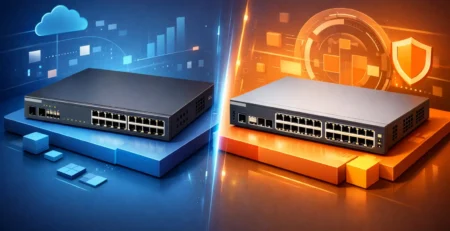
Cisco Switches for Enterprise Networks
When a network refresh stalls, it is rarely because the team forgot to choose a switch. It usually stalls because the requirements are more specific than they looked at first – port speed, uplink type, PoE budget, stackability, software image, module support, and whether the hardware has to fit an existing Cisco environment. Cisco switches remain a standard choice in enterprise networks because they cover that level of detail across campus, branch, data center, and industrial deployments.
Why Cisco switches still lead in enterprise buying
Cisco has stayed relevant for a simple reason: the portfolio is broad enough to match different network roles without forcing a one-size-fits-all approach. An access layer deployment for office users has very different priorities than a top-of-rack data center build or a compact branch rollout. Cisco addresses those differences with distinct switch families, licensing models, and hardware capabilities.
For procurement and infrastructure teams, that matters because network purchases are rarely isolated. A switch is usually part of a larger design decision involving optics, power supplies, uplink modules, software entitlements, and compatibility with installed hardware. Cisco fits well in organizations that want consistency across routing, switching, wireless, and network management, but it also works in mixed-vendor environments where the requirement is simply stable Layer 2 and Layer 3 switching from a known platform.
That said, Cisco is not automatically the right answer for every project. Budget-sensitive rollouts, highly standardized low-complexity sites, or environments with minimal operational dependence on Cisco tooling may compare other vendors closely. The value of Cisco tends to increase when uptime, supportability, feature depth, and long-term expansion matter more than lowest upfront price.
Core Cisco switch categories
Cisco switching is easier to evaluate when you look at it by network role rather than by brand alone. Most enterprise buyers are not choosing between random models. They are matching a hardware family to a use case.
Access layer Cisco switches
Access switches connect end devices such as desktops, phones, access points, printers, cameras, and local edge equipment. In this layer, buyers usually focus on port count, PoE or PoE+, multigig capability, uplink bandwidth, and stack options. Cisco Catalyst families are common here because they support campus access policies, segmentation, and predictable hardware scaling.
The practical question is not just whether the switch has 24 or 48 ports. It is whether those ports can support current and near-term load. A site rolling out Wi-Fi 6 or Wi-Fi 6E access points may need multigig ports and enough power budget to avoid an early replacement cycle.
Distribution and core switching
At the distribution or core layer, the buying criteria change. Here, teams care more about switching capacity, redundancy, high-speed uplinks, Layer 3 performance, and modularity. Some environments can use fixed-configuration switches with high uplink density, while others need modular chassis-based systems that support larger campus or multi-building designs.
In these roles, backplane capacity and redundancy architecture matter as much as feature lists. If the switch is expected to aggregate multiple access stacks, carry inter-VLAN routing, and maintain service continuity during component failure, then power supply options, supervisor design, and upgrade path should be reviewed early.
Data center switching
Cisco Nexus platforms are often evaluated separately from campus switching because the operational priorities are different. Data center teams look at low-latency performance, high-density 10G, 25G, 40G, 100G, or higher interfaces, airflow direction, data center fabric support, and compatibility with server and storage architectures.
This is where generic switch selection creates problems. A platform that works well in campus aggregation may not fit rack-level density, east-west traffic patterns, or data center automation requirements. Cisco’s value in this segment comes from specialized hardware families rather than brand continuity alone.
Industrial and compact deployments
Not every switch goes into a rack in a climate-controlled room. Industrial and compact Cisco models are used in manufacturing, transportation, utility, and edge environments where size, temperature tolerance, and ruggedized design may matter more than maximum port density.
For branch, retail, and small-footprint installations, compact managed switches can also make more sense than standard enterprise chassis or full-depth fixed units. The right model depends on physical constraints as much as throughput requirements.
How to evaluate Cisco switches before purchase
A switch quote can look complete and still miss critical details. The safest buying process starts with the network role, then narrows to exact technical requirements.
Port configuration comes first. Copper versus fiber, 1G versus multigig, and the number and speed of uplinks should align with actual endpoint and backbone demand. Overbuying can waste budget, but underbuying usually costs more because replacement happens sooner than planned.
Power is the next common gap. If the switch will support phones, wireless access points, or cameras, the total PoE budget matters more than the presence of PoE alone. Two switches with the same port count can support very different edge loads depending on power supply design.
Software and licensing also need attention. Cisco platforms may require specific software tiers or subscriptions to enable routing, security, automation, or management capabilities. For some buyers, that is acceptable because the features are already part of the operating model. For others, especially in straightforward Layer 2 deployments, it changes the cost calculation.
Lifecycle status should never be an afterthought. Current-generation models support longer planning horizons, but many organizations also need compatible legacy Cisco switches for maintenance, expansion, or staged migrations. In those cases, sourcing from a supplier with access to specific model families, modules, and replacement components becomes as important as the original hardware spec.
Where Cisco switches fit best
Cisco is strongest in environments where scale, control, and standardization are part of the operational plan. Large offices, distributed enterprise branches, healthcare facilities, education campuses, logistics sites, and managed customer environments often benefit from the consistency of a mature switch portfolio.
They are also well suited to organizations that need layered procurement rather than one-time purchasing. That includes buyers who may need base switches first, then later add optics, power supplies, stack modules, supervisor modules, line cards, or replacement units that preserve compatibility with the installed base.
For system integrators and MSPs, Cisco often simplifies repeatable design standards. That does not mean every deployment uses the same model. It means the broader ecosystem makes it easier to define supported architectures across access, aggregation, and data center roles.
Common trade-offs buyers should expect
The main trade-off is cost versus depth. Cisco switches often command stronger pricing than lower-cost alternatives, especially when software, support, and accessories are included. For buyers who need advanced segmentation, management integration, and enterprise-grade resilience, that premium can be justified. For basic switching, it may not be.
The second trade-off is complexity versus control. Cisco provides extensive features, but those features require proper planning. If the environment lacks internal network expertise, a highly capable platform can still be underused or misconfigured.
The third trade-off is lifecycle alignment. Some organizations want only current-generation hardware with long runway. Others need exact older models to maintain remote locations or existing standards. Those are different sourcing problems, and they should not be treated the same way.
Procurement considerations that matter in practice
Enterprise switch purchasing is rarely about one SKU. It is about obtaining the complete hardware set without delay or mismatch. That includes rails, redundant power supplies, network modules, uplink transceivers, stacking accessories, and software alignment where required.
This is why specification-driven sourcing matters. A procurement team may know the switch family, but the actual deployment may fail if the wrong power variant, airflow option, or uplink module is supplied. For international or time-sensitive buying, supplier capability is not just about catalog breadth. It is about identifying exact part requirements and supplying them consistently.
For buyers managing refresh cycles, spares strategy is also worth planning upfront. A lower-cost purchase with no realistic path to replacement inventory can create unnecessary operational risk. By contrast, a well-scoped procurement plan accounts for production units, standby units, and the accessories needed to deploy them immediately.
Gear Net Technologies LLC fits naturally in this kind of procurement model because the requirement is often not just a Cisco switch, but the exact switch family, associated components, and support for business-grade sourcing at scale.
Choosing the right Cisco switches for the next phase
The best Cisco switch is not the newest one or the highest-capacity one. It is the one that matches the layer, traffic profile, power demand, software requirement, and lifecycle plan of the network you actually operate. That sounds obvious, but many costly mistakes come from treating switches as interchangeable.
A careful switch decision gives you more than ports. It gives your network room to expand, a clearer path for maintenance, and fewer surprises when a branch grows, an access layer changes, or a failed unit has to be replaced fast. If you start with the exact role the switch needs to perform, the right hardware choice usually becomes much easier to defend.

I am an enthusiastic tech blogger with 15 years of experience in the technology field. I am passionate about sharing valuable insights and helping people who are interested in technology gain useful and practical information. I am originally from Mumbai, India.