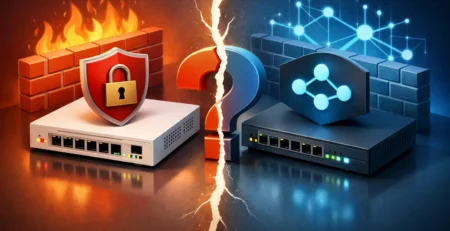
Fortinet vs Sophos for Business Networks
A firewall refresh rarely fails because of marketing. It fails when the selected platform does not match the operating model behind it. That is why the Fortinet vs Sophos decision usually comes down to more than threat prevention claims. For most IT teams, the real question is which vendor aligns better with branch architecture, staffing depth, licensing tolerance, and the mix of security controls already in place.
Both vendors are established choices in network security. Both cover next-generation firewall functions, VPN, SD-WAN capabilities, web filtering, intrusion prevention, and centralized management. But they differ in how they package those capabilities, how they scale, and how much operational overhead they introduce once the appliance is in production.
Fortinet vs Sophos: where the difference shows up first
In technical evaluations, Fortinet tends to stand out for throughput efficiency, hardware acceleration, and breadth across larger security architectures. Sophos often gains attention for usability, synchronized security concepts, and straightforward administration for lean IT teams.
That does not mean Fortinet is only for enterprises or that Sophos is only for small business. Both span multiple deployment sizes. The difference is more practical than categorical. Fortinet often appeals to organizations that want strong performance per appliance, deeper segmentation options, and a wider path into multi-site or hybrid security design. Sophos often fits buyers who value faster onboarding, cleaner policy management for smaller teams, and tighter endpoint-to-firewall visibility within the Sophos ecosystem.
Firewall performance and hardware strategy
If raw performance matters, Fortinet usually enters the conversation with an advantage. FortiGate appliances are widely known for purpose-built hardware acceleration in many models, which can help maintain throughput when security services are enabled. That matters in environments where advertised port speed is not enough and inspection-heavy traffic is the real bottleneck.
For branch offices, distributed retail, schools, and mid-sized corporate sites, this can translate into better headroom during SSL inspection, IPS, and VPN use. It also matters when the firewall is expected to handle SD-WAN, traffic shaping, and internal segmentation without becoming the choke point.
Sophos hardware is capable, but the buying conversation often centers less on silicon strategy and more on feature usability and security integration. In smaller environments, that may be perfectly acceptable. If the site has moderate bandwidth, limited east-west complexity, and a compact user base, Sophos performance can be sufficient without forcing a move into a more expensive appliance class.
The trade-off is simple. If the network is expected to grow aggressively, or if inspection load is likely to rise quickly, Fortinet often provides more confidence in long-term performance planning. If the environment is stable and the main objective is manageable security at a predictable scale, Sophos can be the more efficient fit.
Management experience and day-to-day operations
This is where many real-world decisions are made. A platform can benchmark well and still become costly if policies are cumbersome to maintain.
Sophos has a reputation for being approachable. Policy structure, reporting visibility, and general administration are often easier for smaller IT teams to absorb quickly. That can reduce deployment friction for organizations without a dedicated security engineering function. In managed service environments, it can also shorten onboarding for routine branch deployments.
Fortinet is not difficult in absolute terms, but it is usually more infrastructure-oriented in how teams approach it. Administrators who are comfortable with layered network policy, VLAN strategy, routing logic, and broader fabric integration often appreciate the control. In exchange, there is more to understand, especially when building standardized templates across multiple sites.
That is the central operational distinction. Sophos often reduces administrative burden. Fortinet often provides more room for architectural precision. One is not better by default. It depends on whether the team needs simplicity or control more urgently.
Security ecosystem and platform depth
Fortinet has built a broad portfolio around the firewall. That includes switching, wireless, NAC, sandboxing, endpoint, SIEM-related capabilities, and centralized security operations tooling. For buyers looking at network security as part of a wider infrastructure standard, this matters. The firewall does not sit alone. It becomes part of a larger fabric.
That platform depth can be valuable for enterprises, government environments, large campus networks, and integrators standardizing across many customer scenarios. It can also simplify procurement when one vendor is expected to cover firewall appliances, secure remote access, branch networking, and adjacent security layers.
Sophos takes a more focused approach that many buyers find practical. Its strongest story has traditionally been around coordinated security, particularly between firewall and endpoint telemetry. If the organization is already committed to Sophos endpoint products, the value of synchronized visibility and policy response becomes more tangible.
This is an area where vendor alignment matters more than feature checklists. A standalone firewall comparison may favor one platform on paper, but if the rest of the stack is already moving in a different direction, the operational result can be worse. Buyers should evaluate the surrounding environment, not just the appliance SKU.
Licensing, bundles, and budget control
Pricing comparisons between these vendors are rarely clean because appliance class, subscription scope, support level, and term length all change the picture.
Fortinet often looks strong when measured as performance per dollar, especially in environments that need higher throughput with full security services enabled. But that advantage can narrow if the organization requires additional management, analytics, or ecosystem components beyond the base firewall deployment.
Sophos can be easier to understand from a packaging perspective for some buyers, particularly those purchasing a more contained security stack. For SMB and lower mid-market environments, that simplicity can support faster purchasing decisions and fewer surprises during renewal planning.
The real cost issue is not year-one hardware. It is lifecycle predictability. Procurement teams should assess renewal exposure, feature dependency on subscriptions, support responsiveness, and whether future branch growth will require stepping into a larger model tier earlier than expected. A lower entry price can become expensive if it creates an appliance replacement cycle sooner than planned.
Fortinet vs Sophos by deployment type
For small business and lean IT teams, Sophos is often attractive because it can deliver a capable security baseline without demanding deep specialization. Teams that want usable reporting, straightforward policy administration, and close firewall-endpoint coordination may find it easier to operationalize.
For mid-market organizations, the answer becomes less obvious. This is where both vendors compete well. If the environment includes multiple sites, growing bandwidth demands, segmentation requirements, or a likely move into broader SD-WAN design, Fortinet often becomes the stronger long-term platform. If the network is distributed but operationally simple, Sophos can still be the right call.
For larger enterprises and integrators building standardized security architectures, Fortinet usually has the edge. The combination of appliance range, performance scaling, and ecosystem breadth gives it more flexibility across branch, campus, and data center use cases. That does not eliminate Sophos from enterprise discussions, but it does shift Sophos toward more selective fit scenarios.
Procurement considerations that matter more than brand preference
A firewall decision should be tied to model-specific planning. Buyers need to look at interface requirements, expected SSL inspection load, HA design, remote user counts, VLAN density, power and rack constraints, and support turnaround expectations. Vendor preference is secondary if the selected appliance is undersized or mismatched to the site profile.
This is especially relevant for organizations buying across regions, replacing failed units, or extending legacy estates where compatibility and availability matter as much as feature sets. For procurement teams sourcing enterprise networking hardware and security appliances, the quality of supply support can be as important as the vendor itself. Access to exact models, matching accessories, and responsive fulfillment often determines whether a rollout stays on schedule.
A supplier with technical product coverage across firewalls, switches, access points, modules, and related infrastructure can reduce friction during refresh cycles. That matters when the security project is tied to a broader network upgrade rather than a standalone firewall purchase.
Which one should you choose?
Choose Fortinet if your priority is performance headroom, multi-site scale, deeper network control, or a broader security architecture that may expand over time. It is often the better fit for organizations that treat the firewall as core infrastructure rather than an isolated security appliance.
Choose Sophos if your priority is operational simplicity, manageable administration, or endpoint-aware security in a lean IT environment. It is often the better fit when the team needs fast deployment and consistent day-to-day usability more than maximum architectural depth.
The better buying decision is usually the one that reduces future rework. If your environment is likely to become more segmented, more distributed, or more bandwidth-intensive over the next three years, buy for that reality now. If your main objective is stable protection with lower administrative drag, keep the design disciplined and avoid paying for complexity you will not use.
A good firewall platform should not just pass evaluation. It should remain a practical fit after the first rollout, the first renewal, and the first unexpected change in network demand.

I am an enthusiastic tech blogger with 15 years of experience in the technology field. I am passionate about sharing valuable insights and helping people who are interested in technology gain useful and practical information. I am originally from Mumbai, India.