Difference Between Cisco Catalyst and Nexus
If you are comparing the difference between Cisco Catalyst and Nexus switches, you are usually not choosing between two similar product lines. You are deciding where a switch will sit in the network, what traffic it will handle, how it will be managed, and what operational model your team can support.
That distinction matters in procurement. A Catalyst switch can be the right fit for campus access, branch deployments, and distribution layers, while a Nexus switch is typically selected for data center environments, high-density server connectivity, storage traffic, and low-latency east-west workloads. There is some overlap, but not enough to treat them as interchangeable.
Difference between Cisco Catalyst and Nexus switches at a glance
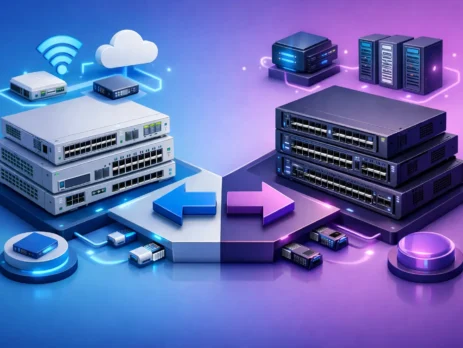
Cisco Catalyst switches are primarily designed for enterprise campus and branch networks. They commonly serve users, endpoints, access points, IP phones, and general LAN segmentation. Nexus switches are built mainly for data center switching, where port density, throughput, latency, virtualization support, and fabric-oriented architectures carry more weight.
The practical difference is less about brand positioning and more about design priorities. Catalyst emphasizes campus operations, access policies, PoE in many models, and user-facing edge connectivity. Nexus emphasizes data center performance, high-speed uplinks, automation frameworks, and architectures aligned with server, storage, and leaf-spine deployments.
Where Catalyst fits best
Catalyst is usually the better choice when the network serves offices, campuses, branch sites, or mixed enterprise environments with heavy endpoint connectivity. If your requirements include access-layer switching, stacking, identity-based policy, and integrated support for wireless and user devices, Catalyst is often the more natural platform.
Many buyers also choose Catalyst when they need Power over Ethernet for phones, cameras, or access points. That alone can remove Nexus from consideration in many edge deployments. Catalyst also aligns well with traditional enterprise LAN refresh cycles where hardware needs to integrate with user access controls, segmented VLAN designs, and centralized campus management.
This does not mean Catalyst is limited to small environments. Large enterprises use Catalyst extensively in access and distribution roles. The point is that its feature set is shaped around campus networking first, not around data center fabric design.
Where Nexus fits best
Nexus is usually selected for data center switching, especially where server racks, virtualization clusters, storage workloads, and east-west traffic patterns dominate. In these environments, low latency, high throughput, and support for data center protocols often matter more than endpoint services like PoE.
Nexus platforms are commonly used in top-of-rack, end-of-row, aggregation, and spine-leaf architectures. They are also more closely associated with data center automation and fabric-based operations. If the switch will connect hypervisors, storage arrays, container platforms, or high-bandwidth application clusters, Nexus is often the better technical fit.
For procurement teams, this usually translates into a straightforward rule: if the switch is buying you user access, think Catalyst first; if it is buying you data center fabric capacity, think Nexus first.
Operating system and management differences
One of the most important differences between Cisco Catalyst and Nexus switches is the software environment. Catalyst models generally run IOS XE, while Nexus platforms run NX-OS. That affects CLI behavior, feature structure, automation methods, and operational familiarity.
For teams with a long history of enterprise LAN administration, Catalyst may feel closer to established campus workflows. Nexus, on the other hand, is tuned for data center operations and often fits better where teams already manage server, virtualization, and fabric-oriented infrastructure.
This is not just a training issue. It affects change control, standard templates, automation scripts, and support procedures. A technically capable team can manage both, but the operational overhead is lower when the platform matches the environment it was designed for.
Hardware priorities and interface profiles
Catalyst and Nexus also differ in hardware emphasis. Catalyst lines often focus on access-port density, multigigabit options in some models, PoE or PoE+, uplink flexibility, and campus stackability. Nexus lines typically prioritize high-speed interfaces such as 10G, 25G, 40G, 100G, and beyond, with models designed for dense server and aggregation deployments.
That changes the buying conversation. A campus buyer may be comparing copper access ports, uplink modules, and power budgets. A data center buyer is more likely to evaluate buffer behavior, port speed migration, latency characteristics, airflow direction, and optical transceiver planning.
Airflow is a good example of how different these families are. In campus closets, airflow direction may not be a major purchase driver. In a data center rack row, front-to-back or back-to-front airflow can be a hard requirement.
Feature sets: campus services versus data center capabilities
Catalyst is commonly associated with enterprise access features such as PoE, segmentation, policy enforcement, user onboarding, and campus resiliency. Nexus is more often tied to data center features such as VXLAN, EVPN support in relevant architectures, high-speed fabric roles, and virtualization-aware networking.
There is no value in reducing this to a simple list of features because actual support varies by model and software release. What matters is feature intent. Catalyst features generally support people, devices, and branch or campus traffic patterns. Nexus features generally support applications, workloads, and data center traffic patterns.
This is where some purchase mistakes happen. Buyers sometimes choose Nexus because it sounds more advanced, even though the environment is a standard office LAN with phones and access points. Others choose Catalyst for a server environment, then discover that the data center design has already outgrown a campus-first platform. Matching intent to deployment is more useful than comparing marketing tiers.
Licensing, support, and lifecycle planning
Licensing can influence total cost as much as port count. Catalyst and Nexus both have licensing considerations, but the structure and commercial impact depend on the series, software tier, and deployment requirements. For some organizations, the platform decision is clear technically but shifts during budgeting once support contracts, software entitlements, and feature activation are reviewed.
Lifecycle planning matters just as much. Many enterprise buyers are not building from scratch. They are replacing failed hardware, expanding an existing environment, or standardizing across multiple sites. In those cases, compatibility with current transceivers, power supplies, software baselines, and operational standards may outweigh the appeal of a newer platform family.
This is why model-level sourcing matters. Procurement teams often need exact series alignment, not just a general recommendation. A buyer replacing a campus access layer usually needs the right Catalyst family and accessories. A buyer adding capacity in a leaf-spine pod typically needs the correct Nexus model, airflow variant, and interface profile. At that point, broad brand comparison is no longer enough.
Which one is better?
Neither is better in absolute terms. The better platform is the one that fits the network role.
If you are supporting users, endpoints, branch connectivity, wireless edge deployments, or campus segmentation, Catalyst is usually the better operational and commercial choice. If you are building or expanding a data center, supporting virtualization hosts, scaling east-west traffic, or standardizing around a fabric architecture, Nexus is usually the better choice.
There are edge cases. Some small data rooms do not need a full data center switching strategy. Some enterprise cores blend campus and application traffic in ways that make the decision less obvious. In those cases, the right answer depends on bandwidth forecasts, existing standards, and whether the environment is evolving toward a campus-centric or data-center-centric design.
How buyers should make the decision
Start with the role of the switch, not the product family. Ask what will connect to it, what traffic profile it will carry, whether PoE is required, what uplink speeds are needed, and which operational team will manage it. Then review software compatibility, transceiver requirements, rack conditions, and lifecycle status.
For organizations buying at scale, the fastest path is usually to define the exact deployment context first: campus access, campus distribution, branch, top-of-rack, aggregation, or spine. Once that is clear, the Catalyst versus Nexus question becomes easier and the model shortlist gets narrower.
If you are sourcing Cisco switching for refresh, expansion, or replacement, working with a supplier that understands model specificity, accessory compatibility, and current versus legacy availability can shorten the procurement cycle. For businesses that need exact enterprise networking hardware, Gear Net Technologies LLC supports that kind of specification-led purchasing through https://gntme.com.
The useful question is not which family is more powerful. It is which one fits the job without adding cost, complexity, or design compromises you will have to correct later.