Cisco Switch Power Supply Replacement Guide
A failed PSU rarely announces itself politely. More often, a Cisco switch starts logging power alarms, a redundant feed drops out, PoE capacity changes unexpectedly, or the chassis stays up on one supply while your maintenance window gets shorter. In that moment, cisco switch power supply replacement is not just a repair task. It is a compatibility, uptime, and procurement decision. For businesses across the UAE, having reliable cisco power supplies support is critical to keeping your network infrastructure running without interruption.
When a Cisco switch power supply replacement is actually the right fix
Not every power issue is caused by a failed PSU. Cisco switches can show similar symptoms due to circuit problems, faulty power cords, fan failures, power shelf limits, or sensor errors. Before replacing a PSU, rule out these external factors to avoid unnecessary downtime and costs.
Check the switch status and hardware logs first. If the switch reports a PSU as failed, absent, unsupported, or outside normal operating limits, the PSU is likely faulty. If problems appear only under heavy PoE loads, the PSU may not provide enough power rather than being completely failed. This is common in modular and high-density switches, which can boot normally but still fall short of the required PoE budget.
Physical inspection is also important. Replace any PSU showing no LED activity, intermittent startup, unusual fan noise, or signs of heat damage. In dual-PSU systems, compare both units under the same power conditions. This helps determine whether the PSU or the external power source is causing the problem.
Cisco switch power supply replacement starts with compatibility
The biggest purchasing error in cisco switch power supply replacement is assuming that any PSU from the same vendor or switch family will fit and function correctly. Cisco power architecture is model-specific. Mechanical fit, connector type, airflow direction, power rating, software support, and redundancy behavior all need to match the platform. This is a common challenge for UAE enterprises managing large or mixed Cisco environments where cisco power supplies support needs to be both fast and accurate.
For fixed-configuration switches, the replacement path is usually straightforward but still specific to the product family. Catalyst access switches, industrial switches, and compact models may use different PSU designs even within similar generation ranges. Some units have field-replaceable hot-swappable PSUs, while others rely on internal or external power designs that are not intended for quick in-rack replacement.
For modular platforms, compatibility is tighter. Chassis switches and larger aggregation systems may require a precise PSU type based on line card population, fan tray design, input voltage, and installed supervisor modules. In these environments, under-specifying power can create a partial operational problem rather than a clean failure. The chassis may remain online, but capacity, redundancy, or PoE availability can be reduced.
Input power type is another common checkpoint. AC and DC supplies are not interchangeable, and some enterprise sites in the UAE use mixed environments where procurement teams need to confirm the local power standard before placing an order. A replacement that is correct in wattage but wrong in input type will still delay recovery.
Hot-swappable versus scheduled replacement
Whether the replacement can be performed without downtime depends entirely on the switch model and current PSU design. Many enterprise Cisco switches support hot-swappable power supplies, particularly where dual-redundant operation is part of the platform design. In those cases, replacing one failed PSU while the second remains active is standard practice, assuming the load is within the capacity of the remaining unit. For UAE businesses where network downtime directly impacts operations, understanding this distinction is essential when seeking cisco power supplies support.
That said, hot-swap support does not remove the need for caution. A heavy PoE load, an unstable input source, or a degraded secondary PSU can create hidden power weaknesses. Removing the failed PSU may expose these weaknesses and affect switch operation. The safe approach is to verify the active supply status, current load, and power budget before removal.
Some smaller Cisco switches do not support true field hot-swap PSU replacement. In those cases, replacement becomes a scheduled maintenance event, and the main procurement priority shifts from redundancy to restoration speed. Knowing that difference before a failure occurs helps avoid last-minute confusion in production environments across the UAE.
Why wattage matters beyond simple uptime
It is easy to focus only on whether the switch powers on after replacement. In real deployments, wattage affects more than boot status. On PoE switches, the available PSU rating directly impacts how much power can be delivered to access points, phones, cameras, and other endpoints. Replacing a higher-capacity PSU with a lower-rated compatible unit may restore switching functions while creating downstream endpoint failures.
This is especially relevant in branch and campus environments across the UAE where device counts have grown over time. A switch that originally supported a modest PoE load may now be powering Wi-Fi 6 access points, phones, and surveillance devices simultaneously. In that scenario, PSU selection is part of service continuity, not just hardware repair. Proper cisco power supplies support ensures your wattage requirements are matched correctly from the start.
What to verify before ordering a replacement PSU
The fastest way to avoid a procurement delay is to match the replacement against the actual installed switch and operating condition, not against a broad family label. Product labels, CLI inventory output, and existing PSU part numbers should all be checked together.
In most UAE business environments, the critical verification points are the exact switch model, Cisco PSU part number, wattage, AC or DC input, airflow requirements where applicable, and whether the switch is using one or two PSUs in a redundant design. If the deployment includes PoE or high thermal load, available power budget should be reviewed at the same time.
It is also worth checking platform lifecycle status. Some Cisco switches remain widely deployed long after their original sales cycle has ended. For those models, sourcing can become more difficult if teams wait until the failure occurs. Legacy and current-generation hardware often require different procurement channels, and availability can vary sharply by region — including across the UAE and wider GCC markets.
For buyers managing multiple sites across the UAE, standardizing approved replacement PSU SKUs by switch family saves time. It reduces the chance of ordering a near match that does not meet operational requirements.
Installation considerations for Cisco switch power supply replacement
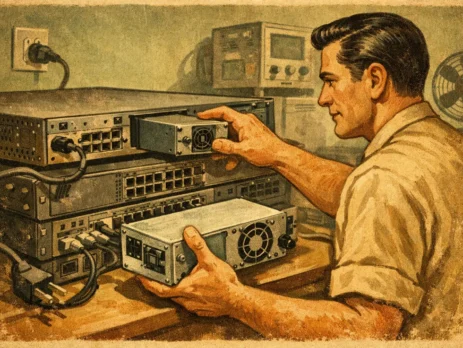
Once the correct unit is in hand, installation is usually straightforward, but the environment still matters. Follow standard procedures by using ESD protection, inserting the PSU correctly, securing retention screws or latches, and verifying the power source before installation. A loose or partially seated PSU can produce the same alarms as a failed one.
After insertion, confirm that the switch recognizes the power supply correctly. LED status is helpful, but it should not be the only check. Review the switch logs, PSU health status, and if relevant, the PoE budget after the replacement is complete. Installing the wrong PSU can cause the switch to flag it as unsupported or mismatched, even if the switch accepts it electrically. UAE IT teams should always validate full recognition before closing a cisco power supplies support ticket.
If the failed supply was one of a redundant pair, it is good practice to verify that both units are sharing load as expected. This is where many post-install issues show up. One PSU may be online but not contributing normally due to firmware, compatibility, or internal hardware limitations.
New, spare, or replacement stock decisions
For enterprise buyers across the UAE, the purchasing question is often broader than replacing one failed part. It may involve whether to keep spare Cisco PSUs on hand for field service, whether to buy exact replacements for installed base preservation, or whether repeated PSU failures are signaling the need for broader hardware refresh planning.
There is no single answer. For stable environments with large installed switch populations, carrying spare power supplies reduces downtime and simplifies maintenance. For aging platforms near refresh, a direct replacement may be justified only when it supports a short-term continuity plan. If a site is already experiencing repeated thermal or power instability, replacing the PSU alone may not solve the underlying risk.
This is where supplier depth matters. Teams managing branch deployments, campus networks, and inventory planning in the UAE often require both current and legacy Cisco power supplies. Gear Net Technologies helps businesses source the right replacement units while supporting broader infrastructure procurement needs.
Procurement mistakes that cost time
The most common delays are predictable. Ordering by switch family name instead of exact model, overlooking AC versus DC input, ignoring PoE load requirements, and assuming all field-replaceable Cisco PSUs are hot-swappable are the usual causes. These mistakes are particularly costly for UAE businesses where procurement lead times can be affected by regional logistics.
Another frequent issue is buying only for the current failure without considering installed redundancy standards. If your switching policy calls for dual PSU operation, replacing one failed unit while leaving the second aged unit untouched may restore service but leave the site exposed. In many production environments across the UAE, replacing or stocking in matched pairs is the more practical decision.
Regional deployment also changes procurement logic. A buyer supporting multiple countries in the Middle East may need to consider local power infrastructure, import timing, and inventory availability at the same time. In those cases, the right replacement is the one that is both technically correct and obtainable within the operational window.
The practical approach
Treat Cisco switch PSU replacement as a compatibility and uptime task. Confirm the fault, verify the exact PSU model, check hot-swap support, and match the PSU to the installed environment. This helps avoid unnecessary downtime caused by ordering the wrong replacement.
For UAE businesses that depend on stable network infrastructure, partnering with a trusted provider for cisco power supplies support makes all the difference. When power infrastructure is part of a production network, replacement speed matters. Accuracy matters more.
Buy Cisco Switch from Gear Net Technologies today.
For pricing and availability, contact us today.
Call us: +971 4 601 2000
WhatsApp: +971 58 581 1786
Email: sales@gntme.com

I am an enthusiastic tech blogger with 15 years of experience in the technology field. I am passionate about sharing valuable insights and helping people who are interested in technology gain useful and practical information. I am originally from Mumbai, India.