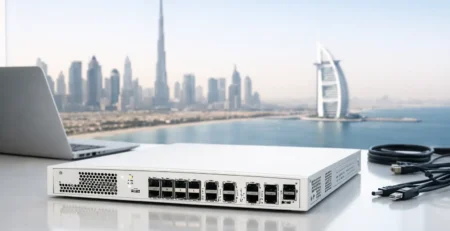
FortiGate 100F for Business Networks
When a branch office starts hitting bandwidth limits, adding cloud applications, and supporting more remote access traffic, firewall selection stops being a routine refresh. The FortiGate 100F sits in that decision point – large enough for serious business use, but still practical for branch deployments, distributed enterprises, and midsize environments that need security inspection without moving straight to a data center platform.
For procurement teams and network architects, the real question is not whether the FortiGate 100F is a capable appliance. It is. The better question is whether its port mix, throughput profile, and role within the network match the site you are sizing today and the traffic pattern you expect six to eighteen months from now.
Where the FortiGate 100F Fits
The FortiGate 100F is typically evaluated for branch offices, midsize business sites, retail hubs, healthcare locations, schools, and distributed enterprise environments that need more than entry-level firewall capacity. It is also a common fit for organizations standardizing on Fortinet security policies across multiple locations while keeping hardware aligned to site size.
This model usually makes sense when the environment needs next-generation firewall functions, VPN, application visibility, and SD-WAN in one appliance. That combination matters in real deployments because many businesses are consolidating edge security and WAN control into fewer platforms. The FortiGate 100F helps reduce hardware sprawl, but the trade-off is that proper sizing becomes more important. If one box is doing more jobs, underestimating traffic growth can create problems later.
In procurement terms, it sits in a useful middle ground. It is not a small office firewall, and it is not intended to replace high-capacity chassis or larger campus edge platforms. It is a business-grade appliance for networks that need consistent policy enforcement, manageable latency, and enough headroom for security services to stay enabled.
FortiGate 100F Hardware Considerations
Hardware selection often gets reduced to raw throughput numbers, but that is only part of the buying decision. With the FortiGate 100F, interface requirements, WAN design, and service density matter just as much as published performance metrics.
A site with dual internet circuits, segmented VLANs, local servers, wireless controllers, and IPsec tunnels needs more than headline speed. It needs the right port availability and the ability to support operational design without awkward workarounds. If your team is planning multiple uplinks, dedicated DMZ segments, or migration from MPLS to internet-based SD-WAN, the appliance has to support that layout cleanly.
This is why technical buyers usually assess the FortiGate 100F in the context of a complete edge design. The appliance may look sufficient on paper, but the real test is whether it supports the intended topology, security inspection level, and resilience model. If your design requires high session volumes, sustained SSL inspection, and a growing number of site-to-site VPNs, conservative sizing is often the better path.
Throughput Numbers Need Context
Firewall throughput, threat protection throughput, and VPN throughput are not interchangeable. Buyers sometimes compare one model to another using only the largest advertised number, which can distort the selection process.
With the FortiGate 100F, the more relevant planning exercise is to estimate realistic mixed traffic. That includes encrypted web sessions, SaaS use, voice traffic, internal application access, and remote user connectivity. Once advanced inspection features are enabled, effective performance changes. That does not make the platform weak. It simply means that real production design should be based on enabled services, not lab-style maximum figures.
Port Density and Expansion Planning
For many sites, port layout determines whether deployment is straightforward or unnecessarily complex. If an environment expects segmented guest access, corporate LAN, voice, management, and server-side traffic, the firewall must support those interfaces without forcing additional switching solely to compensate for poor planning.
The FortiGate 100F is often attractive because it gives business networks room to structure traffic properly. Still, if the location is expected to add more local services, additional circuits, or security zones over time, that should be considered upfront. Buying too close to current utilization may save budget initially, but it can increase replacement frequency later.
Security and SD-WAN in One Platform
One of the practical reasons organizations shortlist the FortiGate 100F is consolidation. Security teams want policy control, while network teams want path selection, application steering, and branch connectivity. A platform that handles both can simplify deployment and reduce the number of edge devices in service.
For distributed businesses, that consolidation supports standardization. A common appliance family across branch sites makes it easier to keep policies aligned, manage firmware strategy, and reduce operational variance between locations. This is especially useful for managed service providers and system integrators that support multiple customer environments.
The trade-off is that consolidation raises the importance of change control. If the firewall is also central to WAN path decisions, every policy update should be reviewed with both security and network operations in mind. The FortiGate 100F supports that converged role well, but organizations still need disciplined administration around it.
When the FortiGate 100F Is the Right Choice
The FortiGate 100F is generally a strong fit when a site needs enterprise firewall features with enough scale for active branch traffic, multiple WAN links, and growing security inspection requirements. It is also a practical choice when the business wants to standardize on Fortinet for branch security rather than manage mixed firewall models across the estate.
It works particularly well in environments where internet connectivity is business-critical and application performance has to be managed across more than one carrier. In those cases, SD-WAN capability is not a bonus feature. It is part of service continuity.
From a buying perspective, it also makes sense for organizations that want an appliance with meaningful business capability but do not need to overbuy into a larger platform tier. That balance matters for regional offices, multisite retail groups, healthcare branches, and professional services firms with a moderate to high dependency on cloud applications.
When to Size Above or Below It
Not every site needs a FortiGate 100F. Smaller offices with light user counts, limited segmentation, and minimal on-site services may be better served by a lower-tier appliance. Buying above the requirement can complicate cost control, especially when replicated across dozens of sites.
On the other hand, some environments should move higher immediately. If a location has aggressive growth forecasts, heavy SSL inspection demand, larger VPN populations, or a role as a regional aggregation point, selecting a larger model at the start may avoid an early refresh. This is where procurement and engineering need to work closely. The cheapest acceptable option is not always the lowest total cost over the lifecycle.
Common Sizing Mistakes
One mistake is sizing for user count alone. A 100-user site with light web access is very different from a 100-user site running voice, video, cloud ERP, endpoint telemetry, and constant VPN activity.
Another mistake is ignoring future service activation. Some organizations deploy a firewall with only basic policies, then enable deeper inspection months later. If the platform was sized only for initial use, performance complaints often appear after the security posture improves.
A third mistake is treating every branch as identical. Standardization is useful, but branch profiles vary. The FortiGate 100F may be ideal for some locations and oversized or undersized for others.
Procurement Factors Beyond the Appliance
For business buyers, product selection is only part of the transaction. Availability, licensing alignment, warranty expectations, and deployment timing often matter just as much as hardware specifications.
That is especially true for replacement projects and multi-site rollouts. If a failed firewall needs to be swapped quickly, the value of a supplier comes from stock access, model accuracy, and the ability to support exact part requirements without delays. For expansion projects, consistency across ordered units matters because mixed hardware revisions or mismatched licensing can slow implementation.
This is where a technical infrastructure supplier adds value. Gear Net Technologies LLC serves buyers who need precise model sourcing, procurement support, and access to enterprise networking hardware for rollout, maintenance, and replacement cycles. For teams managing scheduled upgrades or urgent edge refreshes, that procurement reliability is often as important as the spec sheet.
A Practical Buying View of the FortiGate 100F
The FortiGate 100F is best understood as a serious branch and midsize edge platform, not a generic firewall checkbox. It fits organizations that need strong security controls, SD-WAN capability, and enough hardware capacity to support real business traffic with room for policy growth.
It is not automatically the right answer for every location, and that is exactly why it remains a relevant model to evaluate carefully. In infrastructure purchasing, the best hardware choice is rarely the most advertised one. It is the one that matches the network role, security plan, and operational timeline without forcing compromise a year from now.
If you are assessing the FortiGate 100F, treat the decision as part of the wider edge design. That approach usually leads to a better appliance choice, fewer change orders, and a network that stays stable when business demands increase.