CE8850-64CQ-EI Specifications and Buying Checks
The CE8850-64CQ-EI is built for high-density data center switching where 100GE uplinks, aggregation capacity, and predictable hardware compatibility matter more than generic port counts. For procurement teams replacing a failed switch, expanding a spine layer, or standardizing a new fabric, the model number is only the starting point. The exact port media, software feature set, power configuration, airflow direction, and support requirements must align with the existing network design.
What the CE8850-64CQ-EI Is Designed to Do
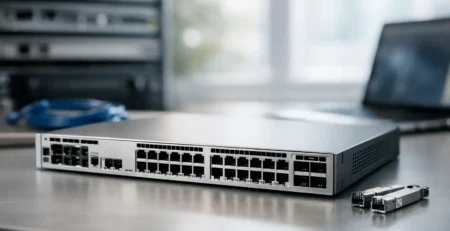
The CE8850-64CQ-EI belongs to Huawei’s CloudEngine data center switching portfolio. Its 64 high-speed QSFP-class interfaces make it suitable for environments that need substantial 100GE density in a fixed-form-factor platform. Typical use cases include leaf-spine architectures, core aggregation, data center interconnect, large-scale virtualization environments, storage connectivity, and high-bandwidth enterprise workloads.
For an organization moving from multiple lower-speed aggregation switches to a consolidated 100GE design, a 64-port platform can reduce the number of devices, inter-switch links, rack units, and power connections required. That consolidation can simplify cabling and operations, but it also increases the importance of resilience planning. A single high-density switch may carry a large concentration of workloads, so dual-homing, redundant paths, and compatible peer equipment should be part of the design discussion before purchase.
The EI designation generally identifies an enhanced feature tier within the product family. Feature availability still depends on the installed software release, license entitlement, hardware revision, and network operating mode. Buyers should not assume that a capability available on another CloudEngine model is automatically enabled on the CE8850-64CQ-EI.
CE8850-64CQ-EI Port Planning Before You Order
The most visible specification is the 64-port high-speed interface count, but procurement accuracy depends on what will connect to those ports. A QSFP port does not by itself define the deployed link speed, distance, or cable type. The final design may require optical transceivers, active optical cables, direct-attach copper cables, breakout assemblies, or compatible third-party optics approved under the customer’s operating policy.
Start with the intended connection map. Identify how many interfaces will terminate on servers, leaf switches, core switches, storage systems, firewalls, or WAN edge equipment. Then confirm the speed required at each endpoint. A 100GE interface can support different deployment approaches depending on the hardware, optics, breakout support, and software configuration, but these options must be validated against the exact platform documentation and release level.
Distance is equally important. Short in-rack links may be well suited to DAC or AOC assemblies, while row-to-row and building-to-building connections may require multimode or single-mode optical modules. The wrong optic type can create unexpected cost, compatibility, or reach limitations even when the switch model is correct.
For large orders, document the interface plan at the part-number level. The switch, transceivers, cables, power supplies, fan modules, rail kits, and license items should be treated as one bill of materials rather than separate purchases. This is particularly useful when equipment is being shipped to a remote site or deployed by a system integrator that may not have immediate access to replacement components.
Power, Airflow, and Rack Compatibility
High-density 100GE switching places significant demands on the physical environment. Before placing an order, confirm the input power requirements, quantity of installed power supply units, redundancy method, and power-feed availability in the target rack. A switch may support redundant power supplies, but redundancy only provides value when the supplies are connected to independent power paths and correctly rated PDUs.
Airflow direction is a frequent source of avoidable deployment delays. Data center rows are commonly designed around cold-aisle and hot-aisle containment. The installed fan and power-supply airflow direction must match the facility standard. Mixing airflow variants in the same rack can reduce cooling efficiency and may create thermal issues under sustained traffic load.
Rack depth, rail support, cable-management space, and front-to-rear clearance also deserve attention. A fully populated high-speed switch can require substantial bend radius for optical cables and breakout assemblies. Leave adequate space for service access, power connections, and future port additions. In dense environments, cable planning is not a finishing task. It is part of the switch selection process.
Software, Licensing, and Feature Validation
A network switch is not purchased solely for its forwarding interfaces. Its operational value comes from the feature set that supports the intended architecture. Depending on the deployment, the customer may require Layer 2 and Layer 3 switching, EVPN-VXLAN, BGP, multicast, link aggregation, QoS, telemetry, automation interfaces, access controls, or data center fabric functions.
The right question is not whether the CE8850-64CQ-EI family can support an advanced feature in principle. The right question is whether the specific hardware and software combination being purchased supports that feature in the required topology. Software versions can affect protocol behavior, scale limits, interoperability, and the available command set. Licensing can affect access to features, capacity tiers, or support services.
For replacement projects, capture the current switch software version and configuration before sourcing equipment. Matching the existing release may be preferable when restoring service quickly, while a planned upgrade can make sense for a broader modernization project. These are different procurement situations. A like-for-like replacement prioritizes speed and compatibility. A fabric refresh should evaluate lifecycle status, migration sequencing, and long-term software support.
Interoperability in a Mixed Network
Many enterprise networks operate with equipment from multiple vendors. The CE8850-64CQ-EI can be considered within a mixed environment, but interoperability should be tested at the protocol and optics level rather than assumed from interface speed alone. Ethernet links may come up successfully while operational issues remain in routing adjacencies, link aggregation, VLAN handling, MTU settings, flow control, or transceiver qualification.
For a spine-leaf fabric, verify the routing protocol design, ECMP behavior, overlay requirements, and underlay addressing approach. For storage traffic, confirm MTU consistency, congestion-control requirements, and any platform-specific recommendations from the storage vendor. For security appliances and load balancers, validate media type, breakout mode, and supported port speed at both ends.
Where the new switch will connect to legacy hardware, a port-speed and optic compatibility review is especially useful. Older platforms may not support the same transceiver types, forward error correction settings, or breakout configurations as newer 100GE systems. A short validation exercise before a full rollout can prevent an otherwise correct hardware order from becoming a staged deployment problem.
Procurement Checks for Enterprise Buyers
A technical purchase order should state more than the switch part number. Confirm whether the equipment is new, surplus, refurbished, or used; whether it includes factory-installed or separately packaged power supplies and fans; and whether rail kits, console cables, blanking panels, or licenses are included. Condition and accessory completeness are material considerations for maintenance and expansion projects.
Serial-number handling also matters for organizations with asset-management, warranty, or support-contract requirements. Request clear documentation of model numbers, quantities, hardware condition, and included components. For multi-site projects, define whether equipment must be staged, labeled, or grouped by destination before shipment.
Availability can vary significantly for enterprise switching hardware, particularly for specific revisions, legacy configurations, and matching airflow or power variants. A supplier with component-level sourcing capability can help identify alternatives, but an alternative should be reviewed against the original technical requirement. A close model number is not necessarily a functional substitute.
Gear Net Technologies LLC supports business buyers that need exact enterprise networking hardware, associated components, and procurement coordination for infrastructure deployments. For customers sourcing equipment across Africa or through international procurement channels, confirming the full bill of materials before shipment is often the most effective way to protect project timelines.
A Better Way to Specify the Switch
When requesting the CE8850-64CQ-EI, provide the intended role, target port speeds, media type, required optic distances, power-feed standard, airflow direction, software expectations, and required accessories. This level of detail allows a supplier to verify the configuration rather than merely quote a chassis.
The most reliable purchase is the one that arrives ready for the rack, the fabric, and the operational requirements already defined by the network team. For a high-density 100GE platform, that preparation turns a part-number order into deployable infrastructure.

I am an enthusiastic tech blogger with 15 years of experience in the technology field. I am passionate about sharing valuable insights and helping people who are interested in technology gain useful and practical information. I am originally from Mumbai, India.