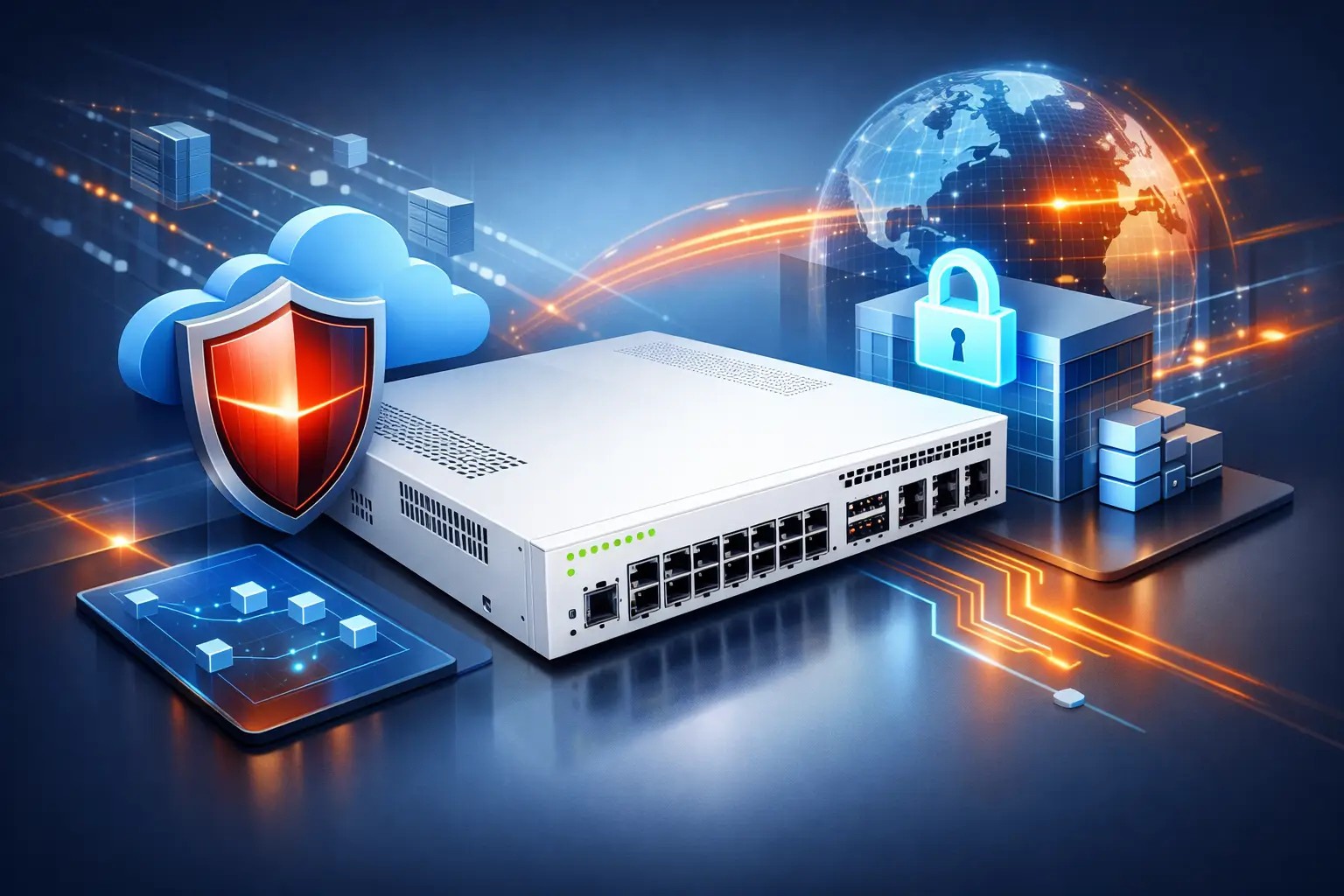
Fortinet-FG-400F for Enterprise Edge Security
When a branch edge starts carrying more encrypted traffic, more cloud-bound sessions, and tighter segmentation policies, entry-level firewall sizing stops working fast. The fortinet-fg-400f sits in the range where many mid-sized and distributed enterprises begin to balance throughput, inspection depth, interface flexibility, and operational control without moving into a much larger chassis class.
For IT buyers and network teams, that matters because firewall selection is rarely about one headline number. It is about whether a platform can hold policy, inspection, VPN, and SD-WAN workloads together under real traffic conditions, while still fitting procurement, rack space, licensing strategy, and lifecycle planning. That is the right way to evaluate this model.
Where the fortinet-fg-400f fits
The Fortinet FG-400F is best understood as an enterprise firewall for organizations that need more than branch-level security but do not necessarily need a data center-class platform at every site. It commonly fits regional offices, campus edges, internet breakouts, secure WAN aggregation points, and environments with a mix of on-prem applications and cloud access.
In practical terms, this is the class of appliance buyers look at when smaller units begin to show limits under SSL inspection, IPS, application control, and user-based policies. If your environment has hundreds to thousands of users, multiple WAN circuits, site-to-site VPN dependencies, and segmented internal networks, the platform becomes relevant quickly.
The appeal is not just raw firewall throughput. It is the ability to consolidate functions that might otherwise require separate appliances or compromises in policy enforcement. For many organizations, reducing hardware sprawl at the edge is a procurement and operations win.
What technical buyers should evaluate first
A model like the fortinet-fg-400f should be assessed against actual traffic patterns, not only vendor lab figures. Security teams know that performance changes once threat protection, deep inspection, logging, and VPN services are active. A firewall that looks oversized on paper can become correctly sized once those services are enabled.
Start with encrypted traffic volume. If a large share of outbound and east-west traffic needs SSL inspection, CPU and ASIC architecture matter more than basic firewall forwarding numbers. Then look at policy density. A simple office internet edge behaves very differently from a segmented enterprise site with VLAN boundaries, identity-aware rules, application signatures, and constant log generation.
High availability is another early checkpoint. If the deployment requires an active-passive pair, synchronized policies, and predictable failover behavior, the hardware decision should account for the full HA design, not just a single unit purchase. Interface requirements also deserve attention. Uplink mix, copper versus fiber handoff, internal segmentation, and downstream switch architecture all affect whether the platform aligns cleanly with the rest of the network.
Security services and operational value
The reason organizations move into this firewall tier is usually not routing alone. It is consolidated security control. The FG-400F is built for environments that want firewalling, intrusion prevention, application visibility, web filtering, VPN, and SD-WAN features in a single platform managed through a common policy framework.
That consolidation can simplify branch standardization. Instead of piecing together separate edge devices for transport control and security inspection, IT teams can centralize enforcement and shorten deployment cycles across multiple sites. For managed service providers and system integrators, that consistency is especially useful when they are supporting repeatable architectures across customer estates.
There is a trade-off, though. The more services you turn on, the more careful sizing becomes. A unit that is a strong fit for NGFW and SD-WAN at one site may be under pressure if the same site later adds heavier remote access VPN demand, broader SSL decryption, or more east-west controls. That is why a procurement decision should factor in the next phase of the network, not only current baseline traffic.
Interface strategy and deployment design
Port layout and interface options often decide whether a firewall fits neatly into an existing topology or creates unnecessary redesign work. Midrange enterprise firewalls are frequently inserted into environments with mixed access layers, WAN handoffs, DMZ segments, and fiber uplinks. Buyers should verify not only interface count, but also the speed classes and media types needed for current and near-term use.
This matters in campus and branch aggregation designs where the firewall may terminate multiple ISP circuits, connect to core switching, and maintain isolated zones for servers, voice, guest access, or third-party connectivity. If too many interfaces must be extended through external switching just to make the design work, complexity rises and troubleshooting gets harder.
For replacement projects, migration path is just as important. If the existing firewall has accumulated tunnels, NAT rules, custom objects, and segmented routing policies over several years, the time to cut over can depend more on configuration cleanup than on hardware installation. The appliance may be straightforward to rack, but the surrounding policy model rarely is.
Fortinet FG-400F in SD-WAN and distributed environments
A common reason to consider the Fortinet FG-400F is the need to combine security inspection with WAN path control. In distributed enterprises, internet links, MPLS remnants, DIA circuits, and application-specific routing all coexist. A firewall in this class can support branch modernization where policy-based path selection, application steering, and secure local breakout are required together.
That approach can reduce dependency on separate WAN edge products, but it is not automatically the best choice for every network. If an organization already has a mature SD-WAN stack deeply integrated into monitoring and orchestration workflows, replacing it with firewall-based SD-WAN may introduce operational change that outweighs hardware consolidation. On the other hand, for greenfield sites or standardized refresh programs, combining these roles can simplify both procurement and support.
For multinational or regional rollouts, supply continuity matters as much as architecture. Standardizing on one firewall family only works if replacement units, compatible subscriptions, and expansion planning can be sourced without long delays. That is often where a specialized infrastructure supplier adds value beyond a generic reseller model.
Procurement considerations beyond the appliance
Experienced buyers know the appliance is only one line item. The full purchasing decision includes licensing terms, support coverage, deployment timing, and compatibility with the broader security stack. Before committing to the FG-400F, teams should confirm the exact software and subscription model needed for their use case rather than assuming all services are included in a base hardware purchase.
This is especially relevant in budget planning. A lower upfront hardware cost can look attractive until required threat protection or management services are added. The right comparison is total operational fit, not a bare appliance price.
Lead time and sparing strategy should also be discussed early. If the firewall supports a business-critical site, waiting for a failure before establishing replacement coverage is risky. Some organizations procure a cold spare, while others align their risk posture with vendor support terms and local stocking availability. The right answer depends on site criticality, geographic reach, and acceptable downtime.
For buyers working through refresh cycles, exact model naming matters. Product-family confusion can create avoidable ordering mistakes, especially where adjacent firewall models appear close in performance but differ in ports, throughput, or role suitability. Technical procurement teams should validate part numbers, support options, and any accessory or optics requirements before issuing a PO.
Is the fortinet-fg-400f the right fit?
The answer depends on where pressure exists in your network. If your current edge is constrained by inspection load, growing VPN demand, or branch consolidation requirements, the FG-400F is in a practical range for serious enterprise deployments. If the site is small and policy-light, it may be more firewall than necessary. If the site behaves like a data center perimeter with very high east-west and north-south throughput requirements, a higher class platform may be the better fit.
For most buyers, the right decision comes from mapping real traffic, active security services, interface needs, and lifecycle expectations against the appliance role. That is more useful than comparing spec sheets in isolation. Gear Net Technologies supports this kind of model-specific sourcing for organizations that need precise enterprise networking hardware aligned to deployment requirements, not broad consumer IT inventory.
A firewall purchase is easiest when the hardware, subscriptions, and replacement path all make sense on day one – but the better outcome is choosing a platform that still makes sense after the network around it changes.