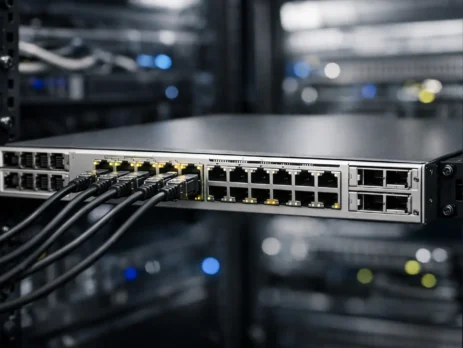
c9500-16x-a for Enterprise Core Switching
When a network refresh reaches the point where distribution and core layers start to limit growth, the Cisco c9500-16x-a usually enters the conversation for a reason. It sits in a part of the switching market where buyers are not looking for basic access connectivity – they are looking for predictable 10 Gigabit density, high availability, and a platform that can carry campus core or aggregation workloads without overbuilding the design.
For procurement teams and network architects, that matters because the wrong switch at this layer creates expensive downstream problems. Port count, uplink strategy, software tier, power model, and rack role all affect whether the hardware will still make sense three to five years from now.
What the c9500-16x-a is designed to do
The c9500-16x-a is a Catalyst 9500 Series switch built for enterprise campus core and aggregation deployments. In practical terms, it is aimed at environments that need high-speed fiber connectivity, policy control, advanced Layer 3 capability, and the operational features expected in a modern Cisco campus architecture.
The 16-port 10G form factor makes it a focused platform rather than a general-purpose access switch. That distinction is useful. If you need large numbers of user-facing copper ports, this is the wrong category. If you need a compact core or aggregation switch with fixed high-speed interfaces, it becomes a much more sensible candidate.
This is why the model often appears in branch headquarters, midsize enterprise campuses, data-rich office sites, healthcare networks, education environments, and managed customer infrastructures where traffic growth has moved beyond 1G uplink assumptions.
Where c9500-16x-a fits best
The strongest use case for c9500-16x-a is a campus core or collapsed core design where 10G fiber links are already standard or planned. It is also a practical option for aggregation when multiple access switches need clean handoff into a routing and policy layer with enterprise-grade resiliency.
For a smaller site, the switch may be more than enough to serve as the network core with room for expansion. For a larger site, it can operate as a distribution or aggregation layer component, especially where port density requirements are moderate but feature requirements are not.
That trade-off is central to evaluating the model. This is not a switch you choose because it has the highest possible port count in the lineup. You choose it because the port profile and software capabilities align with a specific architecture.
Campus core and collapsed core deployments
In a collapsed core design, the c9500-16x-a can simplify topology by combining routing intelligence and high-speed switching into a compact footprint. That can reduce rack space usage and streamline management compared with running separate platforms for distribution and core functions.
The advantage is efficiency. The trade-off is that future expansion depends on how accurately the initial port and throughput assumptions were made. If there is a realistic chance of rapid growth beyond 16 high-speed interfaces, a higher-density model may be the safer buying decision.
Aggregation for fiber-heavy access layers
Where access switches uplink over 10G fiber, the c9500-16x-a offers a clean aggregation point without introducing unnecessary copper capacity. This is especially relevant in office towers, multi-floor enterprise sites, and segmented environments with security, voice, wireless, and application traffic converging upstream.
Because the platform is designed for advanced switching and routing roles, it can support policy-driven segmentation and traffic control more effectively than buyers would get from a lower-tier switch used outside its intended role.
Key buying considerations before you order
Technical buyers rarely struggle with identifying the general product family. The real challenge is ordering the exact variant that matches the deployment plan, licensing position, and compatibility requirements. With c9500-16x-a, that means looking past the model name and validating the details that affect implementation.
First, confirm the intended network role. If the switch will sit at the core, review current and projected uplink consumption, redundancy design, and routing feature needs. If it will be used for aggregation, map the exact number and speed of incoming fiber links and leave room for growth.
Second, check optics strategy early. A 10G-focused switch is only as practical as the transceiver and cabling plan behind it. Procurement delays often happen not because the switch is unavailable, but because compatible optics, patching standards, or link media were not finalized at the same time.
Third, verify software expectations. Cisco platforms can differ significantly depending on the license tier and feature set in use. Buyers should confirm whether the environment requires advanced routing, automation capabilities, security segmentation, or integration with an existing management stack. A switch that is technically compatible but operationally mismatched can create unnecessary cost.
Performance, scalability, and trade-offs
The c9500-16x-a is appealing because it gives enterprise-class capability in a fixed form factor. That often improves deployment speed and purchasing clarity. There is less ambiguity than with modular chassis decisions, and fixed platforms can be easier to standardize across multiple sites.
Still, fixed does not mean universally right. If your network is likely to need rapid port growth, mixed media flexibility, or deeper modular expansion, a fixed 16-port platform may become a constraint sooner than expected. On the other hand, if your design is already stable and fiber-based, the simpler footprint can be a benefit rather than a limitation.
Another practical consideration is lifecycle planning. Enterprise buyers are not just comparing throughput. They are comparing replacement timelines, support continuity, sparing strategy, and consistency across deployed hardware. A model like c9500-16x-a tends to make sense when standardization matters and when the network team wants a clear, repeatable build approach for core or aggregation layers.
c9500-16x-a in procurement and replacement cycles
Many purchases happen under less-than-ideal conditions. A planned campus upgrade is one scenario, but urgent replacement after hardware failure is another. In both cases, exact model identification matters because substitutions at this layer are not always simple.
A buyer replacing an installed Catalyst core switch has to account for interface type, software alignment, rack power, existing optic inventory, and maintenance windows. Even if another switch could perform the role, introducing a different platform may extend testing and change-control requirements.
That is why model-specific sourcing is so valuable for enterprise procurement. The ability to secure the exact c9500-16x-a, along with any associated modules, power accessories, or compatible components, helps reduce downtime risk and protects design consistency.
For regional buyers managing infrastructure projects in the UAE or cross-border hardware acquisition, this becomes even more relevant. Lead times, import handling, and product specificity can shape project schedules just as much as technical approval does.
How to evaluate whether it is the right fit
A simple way to assess c9500-16x-a is to ask four practical questions. Is the network role core or aggregation rather than user access? Are 10G fiber interfaces the primary requirement? Is a fixed high-performance platform preferable to a modular approach? And will the current design remain within this density range over the next refresh cycle?
If the answer to most of those questions is yes, the model is likely a strong fit. If not, then the buying discussion should shift toward density, media flexibility, or architecture changes rather than forcing the switch into a role it was not meant to serve.
For system integrators and MSPs, that evaluation also affects how standardized service offerings are built. A repeatable hardware profile reduces support complexity. For enterprise procurement teams, it lowers the risk of purchasing hardware that solves the immediate issue but complicates future expansion.
Sourcing matters as much as specifications
At this level of infrastructure, buyers are not just buying a switch. They are buying certainty around exact part delivery, compatibility, and deployment readiness. That includes confidence in model accuracy, assistance with related hardware categories, and access to a supplier that understands enterprise network buildouts instead of treating the purchase like a generic IT order.
Gear Net Technologies LLC operates in that model-specific space, where part precision and procurement support matter as much as catalog breadth. For organizations sourcing c9500-16x-a as part of a refresh, expansion, or replacement plan, that kind of supplier alignment can save more time than shaving a small amount off the unit price.
The better question is not whether c9500-16x-a is a capable switch. It is whether it fits the architecture you are building, the interfaces you actually use, and the operational path you expect to maintain after installation. When those pieces line up, it becomes a very practical platform to buy with confidence.