What Is a Cisco Nexus Switch?
If you’re evaluating data center hardware, asking what is cisco nexus switch usually means you’re already beyond basic campus networking. Nexus is not Cisco’s general-purpose access switching line. It is a switch family built primarily for data center, high-throughput, low-latency, and virtualization-heavy environments where port density, resiliency, and fabric design matter. +971585811786
For procurement teams and network engineers, that distinction matters because a Nexus switch is typically selected for a specific role: top-of-rack switching, aggregation, core data center transport, storage traffic handling, or spine-leaf architecture. It is less about buying “a Cisco switch” and more about matching a switching platform to a data center design, feature set, and operating model.
What is Cisco Nexus switch used for?
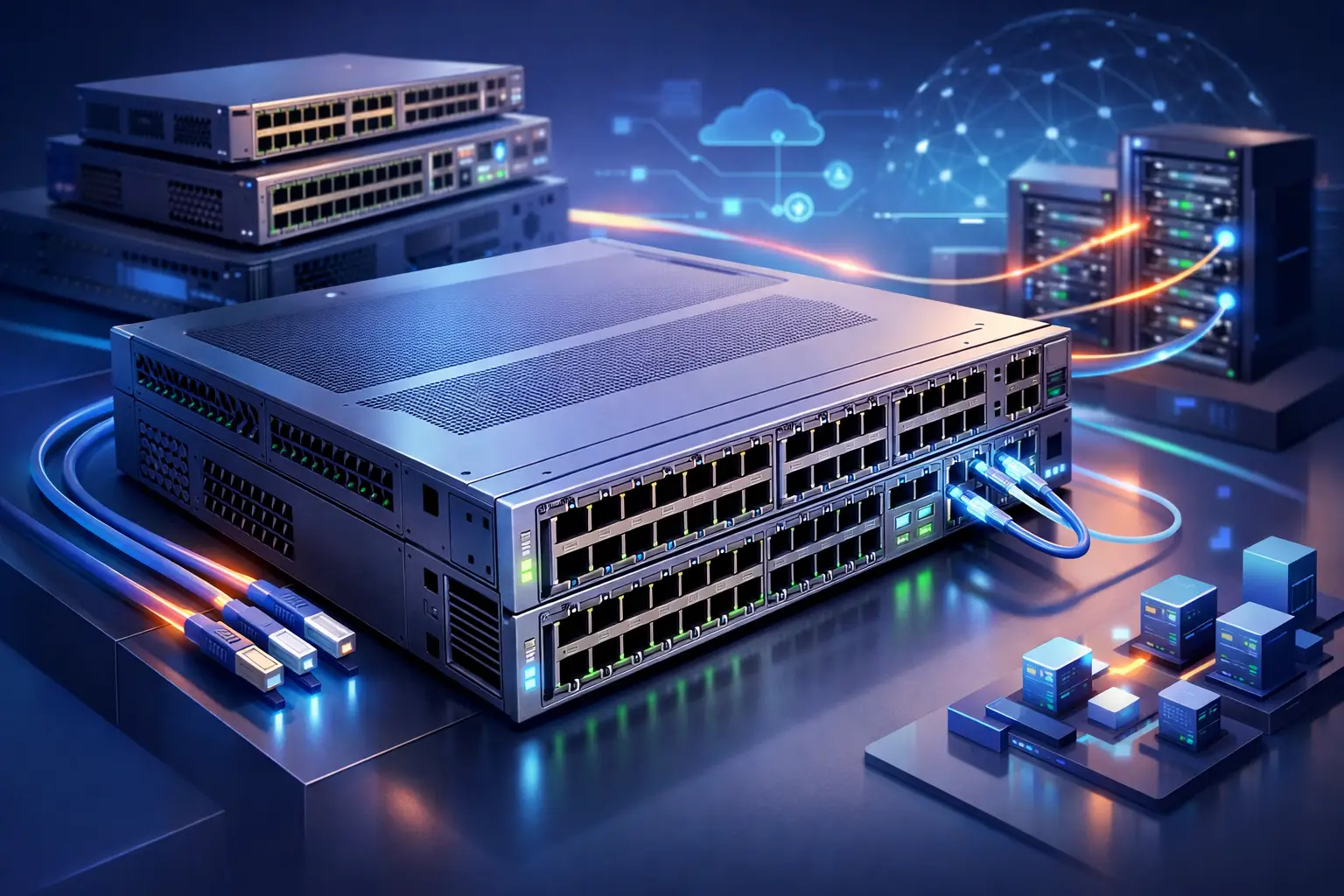
A Cisco Nexus switch is an enterprise and data center switching platform designed to support high-performance Layer 2 and Layer 3 networking, virtualization, automation, and scalable fabric architectures. The Nexus portfolio is commonly deployed in private data centers, colocation environments, cloud infrastructure, and large enterprise server rooms where traffic patterns are east-west as much as north-south.
In practical terms, Nexus switches are used to connect servers, storage systems, hypervisors, firewalls, and upstream network layers with predictable throughput and high availability. Depending on the model, a Nexus switch may provide 1G, 10G, 25G, 40G, 100G, 400G, or mixed-speed interfaces, with support for advanced data center features that are not always the priority in standard campus switch lines.
This is why Nexus often appears in projects involving VMware clusters, hyperconverged infrastructure, large blade chassis, storage networks, and modern spine-leaf topologies. If an organization is building for workload mobility, traffic segmentation, and scale, Nexus becomes a logical candidate.
How Cisco Nexus is different from standard Cisco switches
The easiest way to frame it is this: Catalyst is commonly associated with campus and enterprise user access, while Nexus is associated with data center switching. That is not a hard rule, but it is the practical buying distinction most teams use.
Nexus platforms are engineered around data center requirements such as very high port density, low latency, non-blocking throughput, virtualization integration, and support for fabric-based architectures. Many models run Cisco NX-OS, an operating system designed for data center operations with a command structure that is familiar to Cisco administrators but optimized for this environment.
Another difference is the feature mix. Nexus switches often emphasize capabilities such as virtual PortChannel, VXLAN, EVPN, data center bridging, FCoE support on certain platforms, and programmability for automated provisioning. A campus switch may prioritize user access features like PoE, edge security policy at scale, and branch integration. A Nexus switch usually does not exist to power phones or wireless access points. It exists to move server and application traffic efficiently and consistently.
Common Cisco Nexus switch roles in the network
A Nexus deployment starts with role definition. Buying the wrong role usually creates either unnecessary spend or an architectural mismatch.
Top-of-rack switching
In top-of-rack designs, a Nexus switch sits in or near the server rack and connects local compute and storage nodes. This model simplifies cabling and keeps server uplinks short. It is common in dense virtualization clusters and modular data center deployments.
End-of-row or aggregation
Some Nexus models are selected for aggregation layers where multiple access or rack-level switches uplink into a larger switching platform. Here, the priorities are high backplane capacity, interface flexibility, and resilient uplinks.
Spine layer in leaf-spine architecture
In modern data center designs, Nexus switches are often deployed as either leaf or spine nodes. Leaf switches connect to endpoints such as servers and storage. Spine switches interconnect all leaf switches and provide predictable low-hop transport across the fabric. This architecture scales well and is one of the strongest use cases for the Nexus family.
Storage and converged traffic environments
Certain Nexus platforms are also used in environments where storage networking and Ethernet transport intersect. Depending on the generation and model, support for converged networking features may be relevant for organizations consolidating infrastructure.
Key features buyers usually look for
When technical buyers ask what is cisco nexus switch, they are often really asking what business or operational advantage the platform provides over a lower-tier switching option.
One major advantage is performance consistency under load. Nexus platforms are built for high-throughput environments where server-to-server traffic is constant, not occasional. Another is scalability. A business may start with a pair of rack switches but need to expand into a larger fabric without redesigning the entire environment.
Virtualization support is another major factor. Nexus switching has long been aligned with virtualized and multi-tenant environments, including support for overlay networking and segmentation methods that fit cloud-style designs. Automation also matters. Many IT teams want switches that can integrate with orchestration, policy-based provisioning, and repeatable deployment models.
Then there is hardware modularity. Some Nexus platforms are fixed configuration switches, while others are chassis-based and built for expansion with line cards, supervisor modules, and power redundancy. The right choice depends on growth expectations, maintenance strategy, and whether the organization prefers modular expansion or predictable fixed-port deployments.
Cisco Nexus product families and model selection
Not every Nexus switch is intended for the same environment, and model family matters. Some platforms are compact fixed-form switches intended for top-of-rack use. Others are high-capacity modular systems designed for aggregation or core data center roles.
This is where procurement and engineering teams need to align on specifics: port speed, uplink requirements, airflow direction, power supply type, optics compatibility, software feature licensing, and whether the deployment needs current-generation hardware or support for existing installed infrastructure.
There is also a lifecycle question. In many enterprise environments, Nexus procurement is not only about net-new design. It may involve replacing failed hardware, expanding an installed base, or sourcing matching components for consistency across racks or sites. In those cases, exact model compatibility can matter more than chasing the newest platform.
What to consider before buying a Cisco Nexus switch
A Nexus switch is not automatically the right answer for every enterprise network. If the requirement is branch connectivity, office user access, or PoE-heavy edge deployment, another switching family may be more appropriate. Nexus becomes compelling when the workload profile is data center-centric.
Start with traffic patterns. If most traffic flows between servers, storage, and virtual workloads, Nexus is often a better fit than an access-focused platform. Next, look at speed requirements. A design built around 10G may need room to move to 25G or 100G over time, which changes switch selection.
Operating model matters too. Some teams want deep CLI control and granular data center features. Others prefer policy-driven fabric management. Budget is also part of the discussion. A data center switch may bring capabilities that are justified for production workloads but excessive for smaller environments.
Supportability should not be overlooked. Buyers should confirm transceiver compatibility, software train alignment, power and cooling requirements, rack design, and lead time for spares. In enterprise procurement, the switch itself is only one line item in a broader infrastructure decision.
When Cisco Nexus makes sense
Nexus usually makes sense when uptime, throughput, and scalability are tied directly to business operations. That includes virtualization clusters, ERP back ends, application hosting, database environments, private cloud, and colocation deployments where downtime or congestion has a measurable cost.
It also makes sense when standardization is the goal. Many organizations prefer to keep a consistent switching architecture across racks, pods, or data halls to simplify operations, spare stocking, and configuration management. In that scenario, sourcing the correct Nexus family, modules, and related hardware becomes part of a long-term infrastructure strategy rather than a one-time purchase.
For businesses that need current or legacy enterprise network hardware, model-specific sourcing support can be as important as the technical platform itself. Suppliers such as Gear Net Technologies LLC support this type of purchasing by helping buyers identify exact hardware categories and compatible infrastructure components through https://gntme.com.
Final buying perspective on what is Cisco Nexus switch
The better question is often not just what is cisco nexus switch, but whether your environment needs a switch designed for data center traffic, fabric scale, and infrastructure continuity. If the answer is yes, Nexus is less a brand choice than an architecture choice – one that should be matched carefully to workload demands, port design, lifecycle planning, and replacement strategy. The right platform is the one that fits the network you are actually running next year, not just the one you need online this week.